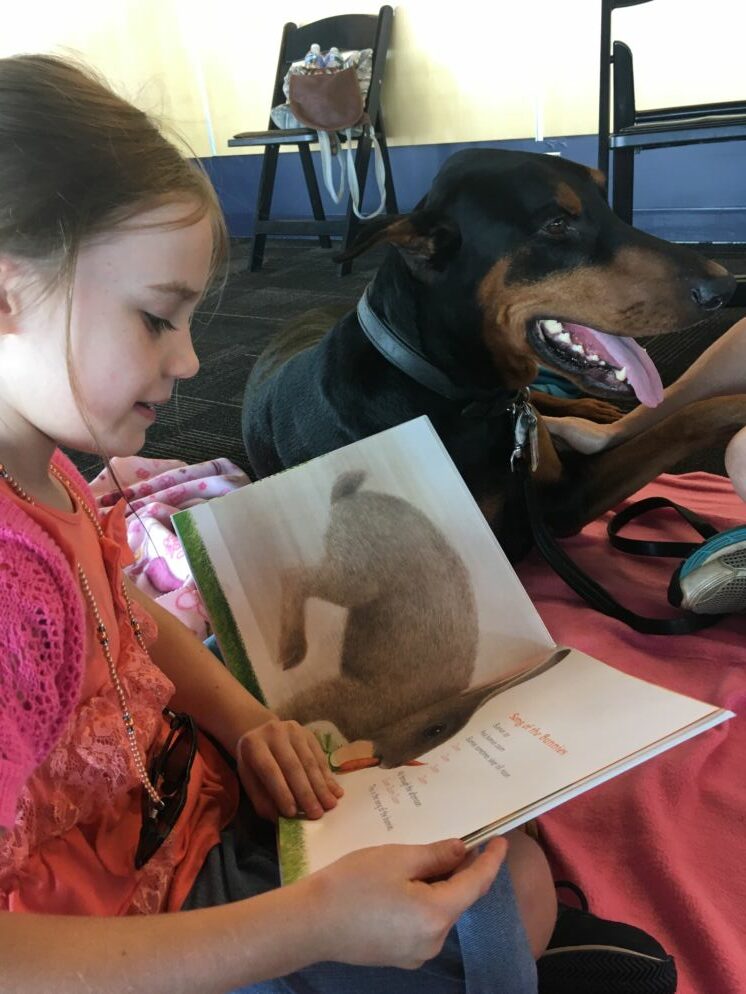
Having a pet around the home adds comfort, companionship and often laughter to family life. But for children undergoing therapies, recovering from an illness or managing a disability, pets have a special job, too.
In honor of National Pet Month in May, here’s a closer look at therapy pets—the gentle and professional unsung heroes trained to assist and emotionally support families in need.
What Are Therapy Pets?
Therapy pets are animals with very important jobs, helping humans in many of the same avenues other therapists do—in physical therapy, in occupational therapy or even just in providing comfort at a challenging time.
Therapy pets, which require extensive training for both animal and handler, and Emotional Support Animals (ESAs), which can be any animal, are not “service animals” under Title II and III of the Americans with Disabilities Act (ADA)—that title is held by dogs alone. Many therapy pets happen to be dogs, however.
Therapy pets can often be cats, horses, miniature horses, rabbits, guinea pigs and rats.
What Therapy Pets Do
According to VCA Animal Hospitals, which has locations throughout the United States, there are three basic types of pet therapy, the most common of which is therapeutic visitation. These animals visit healthcare facilities with their owners.
Animal-assisted therapy involves animals trained to assist physical and occupational therapists with their patients.
The third type is facility therapy. According to Canine Companions, a U.S.-based nonprofit that trains and provides assistance dogs, these therapy pets receive special training to be able to monitor and engage patients with a specific ailment and may be trained in picking up items, opening doors, providing calming pressure or other assistive tasks.
Facility dogs are most seen in occupational, speech and physical therapy, special education, child life and criminal justice settings.
How Do Therapy Pets Help?
Nursing Made Incredibly Easy, a peer-reviewed journal series for nurses, cites pet therapy as being able to help some patients by decreasing stress levels, blood pressure, pain, fatigue, anxiety, fear, isolation and loneliness. At the same time, pet therapy has been shown to improve patient satisfaction, energy levels, self-esteem, mood, motor skills, social skills and more.
It’s well documented that animals can make people feel better, but what is the science behind it?
We spoke with Lisa Osier, a Doctor of Veterinary Medicine with VCA Animal Hospitals, to learn more about the connection humans and animals share and what makes a therapy pet good at its job.
Osier has been in the field of veterinary medicine for two decades. In that time, many of her clients have had therapy pets.
Since Osier was a child, she’s been fascinated by the bond between humans and their animals. Now, as a veterinarian and a pet owner herself, she’s been able to study that bond up close.
“The connection between humans and animals, I mean, I think it goes both ways. I think we all can kind of see, especially with dogs, how much they want to please their people and how much almost immediate love they have for the people that are taking care of them,” Osier says. “On the flip side…I see so many people that almost can’t live without their pet because they bring them such comfort and joy.”
Another ingredient to the success of these animals is their temperament.
“They need to be calm; they need to be minimally reactive,” Osier explains. “A reactive dog is one that startles to noise, other animals or large objects—you want the opposite of that.”
Think your pup has what it takes? The first step for many therapy dogs is to pass the American Kennel Club’s Canine Good Citizen Test. Visit akc.org to find training opportunities near you.

Therapy Pets in the Baltimore Area
Gina Kazimir, executive director of Pets on Wheels, has seen firsthand the impact therapy pets can have.
Kazimir, who lives in Bel Air, first got involved in Pets on Wheels as a volunteer after learning about the organization from the trainer who was working with her family pet.
“We thought it was just a great way to share the joy that pets can bring to people and, as it turns out, it is an incredible experience to be able to bring that kind of comfort, and sometimes excitement and solace, to people,” Kazimir says.
Pets on Wheels is a Maryland-based nonprofit with volunteers who visit libraries, schools, colleges and anywhere people are in need of a furry friend.
“[Pets] don’t ask questions, they don’t make judgements. They simply sit with and hold space for people, and that’s something that is rare in the world,” Kazimir says.
The organization started in 1982 as an experiment to see if pet visitations could help senior “shut-ins.” Since then, Pets on Wheels has grown to include 134 volunteer-pet teams in Baltimore County and more than 400 across Maryland.
“What [we] really do is we make miracles happen,” Kazimir says. “Our therapy pets visit schools, they visit library reading programs, they visit hospitals. We visit community events, hospices—and whenever therapy pets had visits, people feel better.”
Learn more about these dedicated volunteers and their pets at petsonwheels.org.