When the Maryland Science Center first opened its doors in 1976, Baltimore’s Inner Harbor was not the tourist destination that it is today. The harbor had ceased its freight operations in the 1950s, and many of the old warehouses and piers that were used by ships had been torn down and replaced with unoccupied green space. The Maryland Science Center was one of the first major institutions to be built in the Inner Harbor, and would soon be followed by other area staples like the National Aquarium and Port Discovery Children’s Museum.
As the Maryland Science Center prepares to celebrate its 50th anniversary in 2026, it does so in an Inner Harbor that has completely transformed around it. And while the science center has also evolved in accordance with new developments in technology and scientific discovery, its mission has remained the same: teaching science to the next generation in a fun, interactive way.
“Our approach to science is that what you put into it is what you’re going to discover,” says Val Sullivan, the Maryland Science Center’s director of marketing. “All of our exhibits, since our inception, have been focused on being human-powered. … We invite people to have their questions lead their discovery.”
While the science center officially opened in 1976, its history dates all the way back to 1797 when it was founded as the Maryland Academy of Sciences — one of the country’s first scientific institutions.
Over the years, the center has added many of the iconic exhibits that people know it for today, including the “Dinosaur Mysteries” hall of fossils in 2003. This exhibit is set to receive an expansion and refurbishing as part of 2026’s anniversary festivities.
One of the challenges of maintaining a science museum is accounting for newer scientific discoveries that could lead to certain exhibits becoming outdated. This is part of why the science center is always changing, renovating its current exhibits and adding new ones.
Sullivan notes that the “human-powered” nature of the science center has played a key role in guiding its development. While the center’s IMAX theater and planetarium utilize current technology, “You’re not going to see a lot of screens when you come here,” she says. “You really have to use your whole body to explore science in some of our experiences.”

She specifically cites one of the center’s most popular installations, the Bed of Nails, where visitors can experience firsthand how nerve endings in the brain react to certain levels of pressure by laying on a seemingly-dangerous bed of nails and coming out unscathed.
“You could watch someone else lay on it, or climb on top, which can lead to more questions,” Sullivan explains. “Why doesn’t it hurt to lay on a bed of nails? What’s going on here, and what other questions might that lead to?”
One of the Maryland Science Center’s main goals has always been to make science accessible to everyone and encourage them to engage with the world around them. Its exhibits are designed to be comprehensible to people of any age, regardless of their prior knowledge of science.
It’s an approach that has greatly benefitted the center in the past few years, with a renewed interest in STEM (science, technology, engineering and mathematics) education and the COVID-19 pandemic helping to popularize the center’s off-site educational programs. The center’s staff regularly work with science teachers from around the Baltimore area, with their insights influencing its outreach programs, STEM workshops for families and even its exhibits.
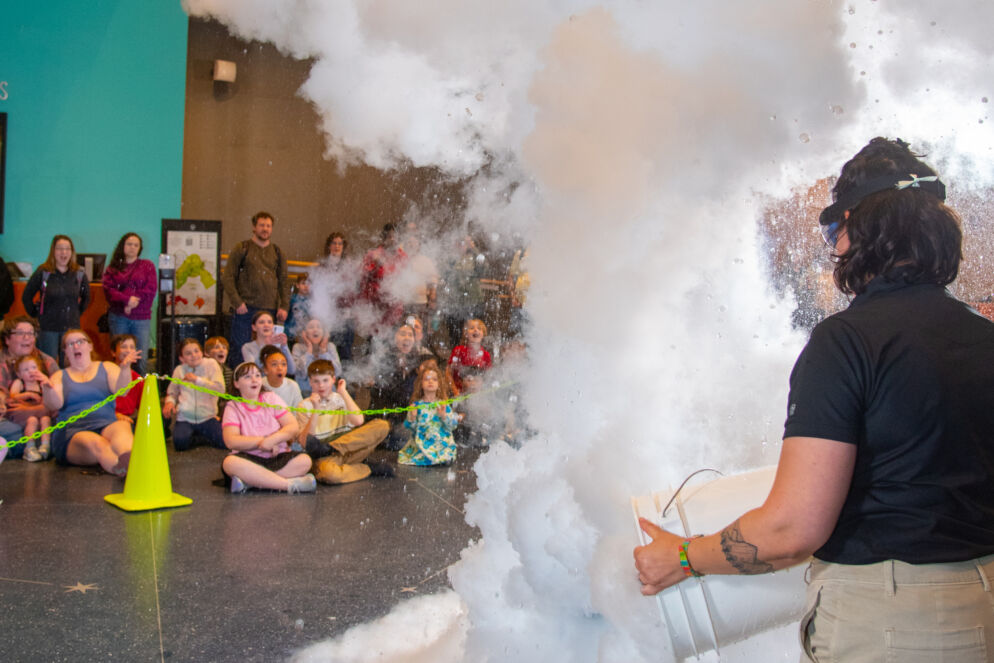
The Maryland Science Center is celebrating the lead-up to its 50th anniversary next year with at least two events every month until a massive birthday celebration set for June 2026. Some of its staple programs will also be altered for the occasion — Mess Fest, on the weekend of Aug. 16 and Aug. 17 this year, will feature a drop of 50 paint-filled balloons and a Coke-and-Pepsi explosion made with 50 bottles of Coca-Cola.
The center will also erect a temporary exhibit highlighting its own history, featuring vintage photography and a “mock field trip” showcasing what the center looked like in the late 1970s.
“Part of what has kept me so attracted to the science center is that working here follows along with our choose-your-own-adventure approach,” Sullivan adds. “There’s always something new to learn about science or museums, and I get to work with a lot of really interesting people and interact with guests from all over the world. That is something I think is very special about the Maryland Science Center.”