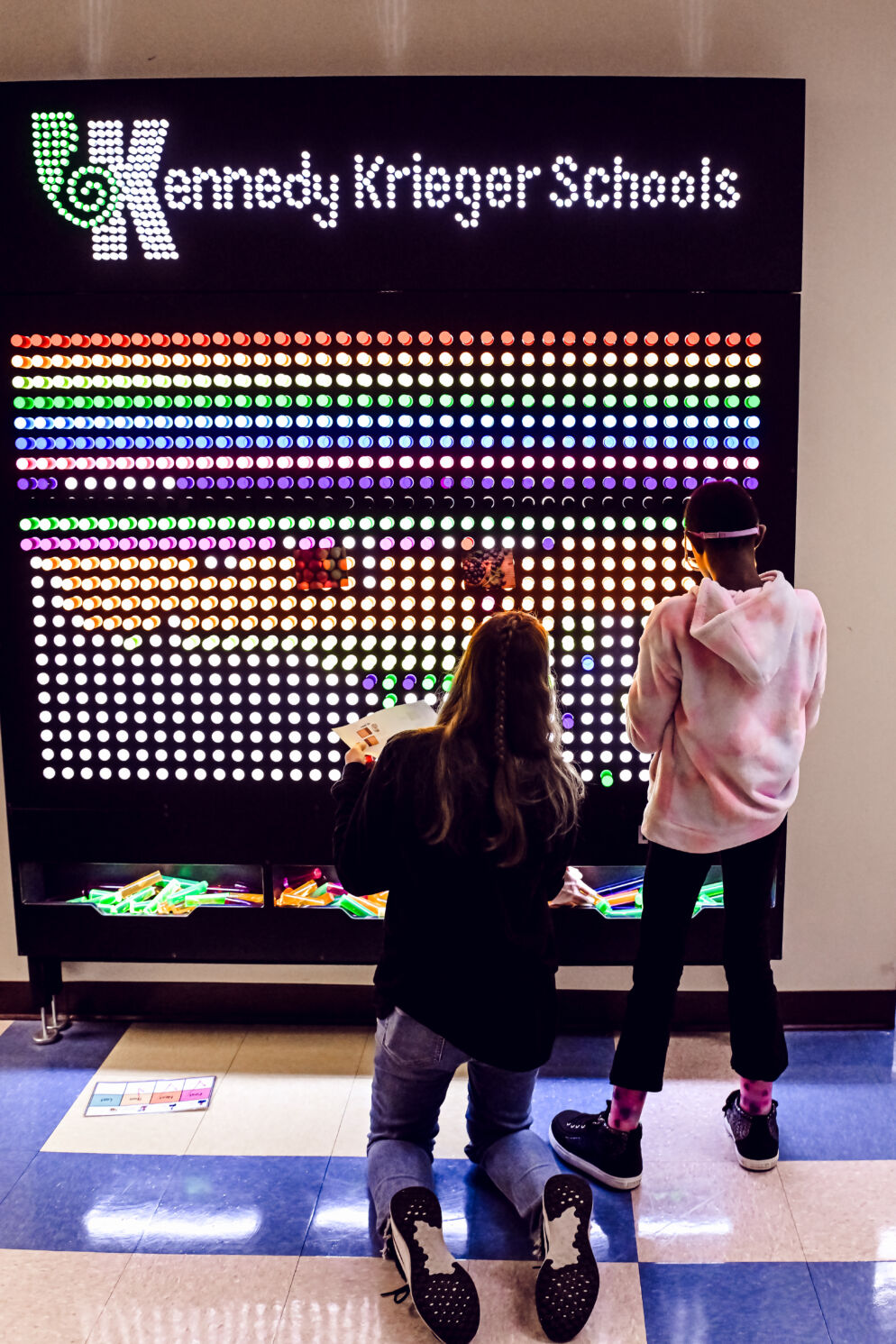
Housed on an unassuming city block in the Washington Hill neighborhood, in the heart of Baltimore City, Kennedy Krieger’s Fairmount Campus sees students hard at work on a Thursday in April.
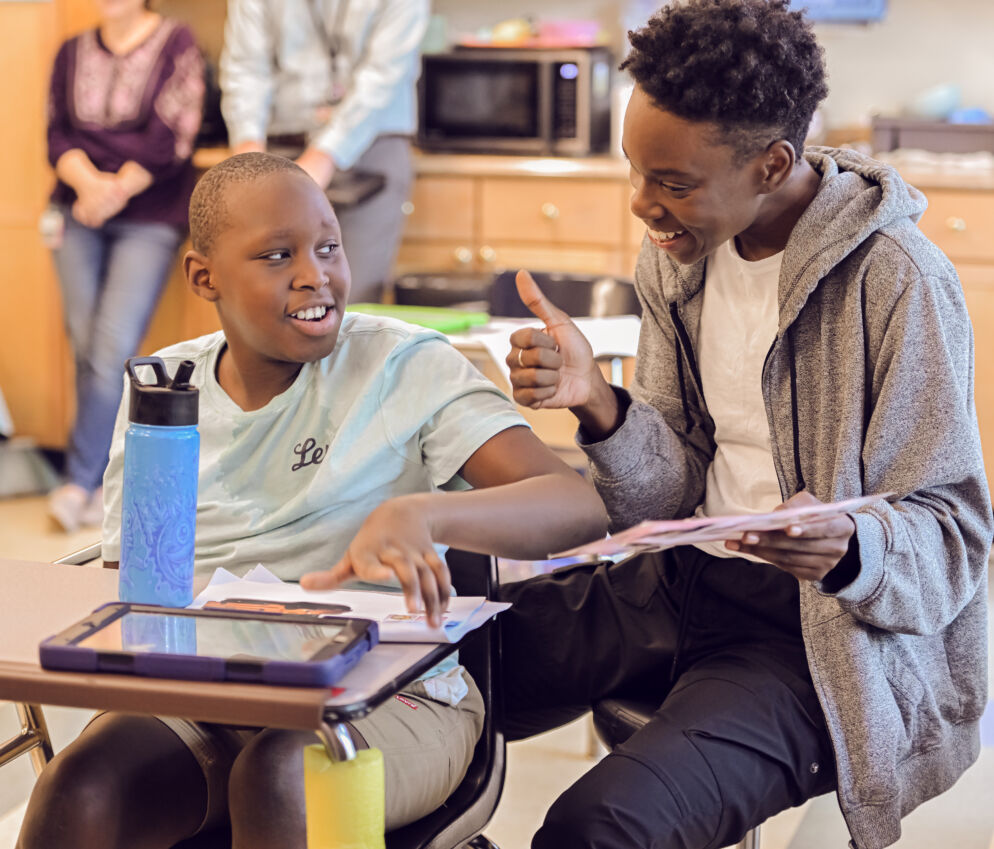
A typical class at Fairmount has students learning from a variety of different mediums, like videos, music and stories. Each student is given their own tablet for classwork and communication, though some students whose families are aiming to reduce screen time opt for paper lesson plans instead.
It may appear like a lesson on any school campus, but for the students here, who have disabilities or neurodivergence, it is much more — a picture of learning at their own pace on their own terms.
“I have eight students, and they’re all on a different wavelength. They’re learning different things,” explains Ashley Burton, who teaches a class of seventh and eighth grade students on the autism spectrum. “I differentiate instruction for [them]. But they’re all learning positive, proactive behavior strategies as well.”
While many public and private schools alike have special education programs for neurodivergent children and children with disabilities, schools that specialize in the field, like Fairmount Campus does, are able to offer more comprehensive accommodations and focus on the needs of their students.
The students at Kennedy Krieger’s schools range from having low to high support needs and include children with autism, learning disabilities, brain injuries and other health issues. Many students require IEPs (Individualized Education Programs), so age-appropriate content taught in the Maryland State Curriculum is adjusted to fit their specific educational needs with the goal of helping them earn a high school diploma, as well as develop communication and emotional skills.
Graduation and the path to employment can be more challenging for students with disabilities. The National Center for Education Statistics reports that 74% of students with disabilities graduate from high school, a decrease from the national average of 84% of students. The statistics for employment are even lower, with the Bureau of Labor Statistics finding that 22.8% of people with disabilities are employed, while the national average is 59.2%.
So, schools that can give students the focused attention they need to address these challenges are critical. Some schools that primarily educate children with disabilities offer career readiness programs so their students are more prepared to enter the workforce upon graduation. Fairmount Campus holds a trades fair annually so students can learn about fields they may be interested in entering.
There are many who advocate for inclusive education that teaches children of all abilities under one school building or in one classroom. The implementation of a wider variety of learning modalities (visual, auditory, kinesthetic, etc.) and behavior supports, as well as the social benefits that come with interacting with peers from a diverse student body, can benefit students of all abilities. But finding the teachers with the skillset to accommodate specialized needs is not always possible.
For the 7.3 million students with disabilities in public K-12 schools — making up about 15% of school enrollment — many public school districts lack the educators needed to serve that population, according to the Pew Research Center.
The number of students with disabilities in these schools has grown over the years as more research is done on disabilities, and more children are diagnosed early in life, but the number of special educators has not grown with that amount, the research shows.
Burton is celebrating her 10th year of teaching at Fairmount Campus in 2026. With that longevity, she is in the unique position grow her own skillset to better serve students.
Like many of the other teachers at the school, she first started as an aide working one-on-one with individual students. The school helps to educate and train staff as much as it does its students, as many of its faculty members have gone on to start their own day cares or therapeutic practices.
Burton notes that since she is able to be present while her students receive occupational therapy, she is able to translate what they are learning in therapy to the classroom and allow them to put those skills to use in a school environment.
“It’s not that [these students] can’t understand or perform certain skills; it’s how the materials are being presented and how they’re being asked to do them,” Burton adds. “Sometimes, you have to bring in things they enjoy or that they’re interested in first to teach them the skill, then generalize it by applying it to other things.”
The Fairmount Campus mission is a natural extension of the Kennedy Krieger Institute’s larger goals of providing treatment and support for children with physical, developmental and behavioral disabilities. Fairmount teaches students in pre-K through eighth grade, while older students can attend Kennedy Krieger High School at the Greenspring Campus.
Because many of the lower/middle school students have been attending since they were in preschool, both teachers and parents can track how their skills are developing as they mature.
“Having known students from second grade and now seeing them in seventh grade is the most rewarding part for me,” Burton says. “It’s seeing all the hard work we put in day after day. When you see it finally click, and they realize it’s clicked … that’s my favorite part of my work.”