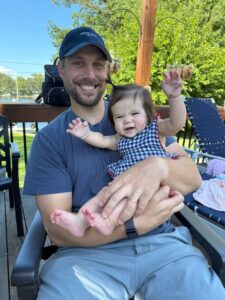
Mike Bassler dreamt of playing pro golf like his grandfather. He got a front-row seat to watching him play because his grandfather helped raise him, acting as a father figure in his life while Bassler’s parents were in recovery for addition.
As his parents became sober, Bassler recalls them being more present in his life, attending sports games, graduations and growing their relationship.
And now, Bassler knows what it’s like to be on the other side of that relationship.
Today, he is a new dad in Abingdon and a little over 12 years sober.
“I know at some point, some age, she will probably ask me about it, and learn that I’m sober,” he says of his 15-month-old daughter. “That’s great. Hopefully she sees that as something endearing. But more so just that I’m there. That I’m present …”
Bassler hopes being open about his story will add to his presence in his daughter’s life, “That she can always call me, she can always ask me any questions … and not be afraid of the topic because I didn’t ask.”
As he reflects on his journey through addiction ahead of his second Father’s Day, he shares how his sobriety affected the way he chooses to show up as a parent and what he learned that can benefit all fathers.
Disrupting the Dream
Bassler’s addiction started when he was a teen. He was a typical child, but when he got to high school and started experiment with drugs and alcohol, he knew he was different from his friends.
“I knew I was different right away because they would have an appropriate reason to stop. The party would end, or we had game the next day, or we had school, or [a] test, or homework or whatever the reason was, [but] I didn’t want to stop. I wanted the party to keep going,” he recalls. “Before I was even 18, I was drinking and using drugs every day.”
Bassler graduated high school with a scholarship to play golf for Loyola University Maryland, but because of his addiction, it became harder for him to make his dream a reality.
“My granddad that raised us, he was a golf pro at a country club in Baltimore, and I really looked up to that,” Bassler says. “That was kind of my dream as a kid, [but] that became quickly unattainable and I gave all that up to just keep drinking and doing drugs.”
After a year and a half of attending college, he dropped out. “I got arrested a few times, and I became unemployable, and … pretty much homeless,” says Bassler.
“There was a family intervention the first time I went [into a treatment center], and I didn’t stay sober,” he adds. “I was pretty young, and I don’t think I was ready.”
Bassler says that it was desperation that eventually led him to sobriety.
“The opioid epidemic was taking off, friends start dying, I was getting in trouble more and more often and I just really got to a point where I knew life could be a whole lot better, and that desperation turned into some willingness for me to do something,” he says.
A New Purpose
Bassler had a friend who had gone to Ashley Addiction Treatment, but at the time, he didn’t have insurance to cover the cost. He got connected to a priest who worked at the local treatment center and was able to help Bassler receive a scholarship in 2014.
Once Bassler finished treatment, he went back to school online for health services management and, once he graduated, he started working for Ashely Addiction Treatment.
“I wanted to be a golfer. I wanted to be the next Tiger Woods,” he says. “But I love my job, and I love the field that I work in, so that’s what I went back to school for.”
As a father, Bassler says what’s most important for him is being present in his daughter’s life — while not neglecting his sobriety. Parents often struggle to balance their own needs with those of their children, but for Bassler, there was more urgency in sticking to the healthy routines that enabled him to be present in the first place.
“It’s easy for me to think that I have all these big responsibilities now, and they’re what’s going to keep me on track. I have to be a father, I have to be an employee, I have to be a husband and provide and take care of the house, and all these things, but it’s not,” he explains.
Some fathers may delay treatment for addiction because they feel they are needed at home, but Bassler recognizes how taking care of his needs can in turn support his family’s needs—something that all fathers can experience with keeping regular healthy habits.
“I need to separate my recovery from that. It’s still very important for me to continue doing the things that got me sober, like my support network and therapy and the 12-step groups that I attended. I need to focus on making sure I still have a good part of that in my life to continue to be sober and to continue to be a father.”